Tremora’s Young Michael Interviews Author Bill Westwood—Fiction

Regarding: Tales of Tremora: The Shimmering by William Westwood Jr.

A young boy who has lost his father is a terrible thing.  Now, a young boy who goes searching for said father and wanders off into a leaky, shimmering veil, deep in the forest of the Cascade Mountains, and finds himself in another world altogether can be a very, very terrible thing.  And, this is how Michael found himself in the middle of a terrific adventure in the land of Tremora.

Just fourteen years of age, Michael is sent off with well-wishes from his worried mother who is on the other side of the shimmering.  She watches him hike down the trodden trail with a little green man named Tracker–Michael’s guide and protector in this curious world.  What Michael doesn’t hear are her final words, said to herself as a whispered afterthought, “Oh, Michael. . . . Now you’re both gone.  I knew you’d choose to stay, of course–it’s in your blood.  And, Megan assures me Tremora needs you. . . . But, please be careful and come back to me safely.  And please, please, Michael, don’t kill your father.”

Michael follows Tracker over hill and dale.  They meet up with wood elves, fairy folk, ogres, a camelop, and a wazalop on their way to the wizard’s gathering where the greatest wizard and magician of them all, Megan, will be presiding.  It is here, Michael finds out the real reason why he is in Tremora—he is to save Prince Cedric from the dragon.  And “finally” he learns where his father is.

I met up with Michael after he spent a couple of weeks training with the wizards.  I had far too much curiosity to know how Bill Westwood could come up with such a unique world for Michael to complete his quest.  Michael had a little time to kill before he was ready to head out again on this next leg of his adventure.  After a brief introduction to Nova, his animal guide, and a few pats on her fuzzy nose from me, we sat down to chat about this amusing, imaginative man who was Michael’s inner guide and overall good-guy creator.

After a little thought about my musings, Michael said that Bill had spent five years in England—the mystical land of elves, fairies, wizards, and the like.  Not only did he spend time with the little folk, but he met his wife there as well.  It was a very important period in his life and set him on a new course to follow his dreams.  Then, he added, “Well . . . it might have something to do with his background as a Russian linguist, and his time spent in the National Security Agency.  I think he probably had some interesting adventures of his own.”

Those years in England provided plenty of time to conjure up a wonderful land for a young boy to travel and have adventures in.  I know how it has changed Michael’s life, but another curiosity I have is about how the book an author is writing changes his own life.  Does writing a book that is so involved and wildly different have any effect on him when he’s writing it or when he’s done?

Michael arched an eyebrow and squirmed a little as he thought about this.  After a bit more fidgeting, he said he wasn’t sure, but he thought it had changed Bill a great deal.  “He spends a lot of time in Tremora, you know.  It took over seven years of Bill’s life to get this far.  Did you know that he is an artist as well?  He has made sculptures of just about all of us.  That’s why I’m stuck here now, waiting. . . . There’s such a backlog for his artwork that he hasn’t had time to get back to “me,” and it is frustrating—I need to go and find my dad, alread!”

We talked some more about the different stories and various authors we knew. That brought me to wonder about another question.  So, I asked if he had any fears that Bill would “kill off” any of the main Tremora characters during these perils.  There are a lot of authors who “do in” their characters to promote more suspense into their storyline.  “Bill loves us all too much, Diane, and he would never do that.”

With that, Michael jumped up, threw his backpack on, and said as he turned and walked away. . . . “Besides, I have to go and save Prince Cedric and my dad.”

If you want to have a little fun, check out Bill’s sculptures here.

Charlie

White_Leghorn_Rooster, WikipediaI was raised by my grandmother.  Back in the mid-60s, in St. Louis, Missouri, she toiled away at the florist’s shop to keep us all alive.  My father drank a bit and was not very regular about his employment habits.  Somehow that woman managed to keep us all fed and even sent us to Catholic school.  My mother, who was very ill, left us.  I was volunteered by my father to keep house for my family at the tender age of five.

I can’t remember a day in my life when I wasn’t totally mesmerized by animals.  I loved them and pleaded to have a puppy or kitten to love because I missed my mother so.  Sadly, my grandmother had her fill from all the creatures my father had dragged home as a boy.  So, I coaxed whatever sick or stray animal that would wander by the yard and closed the gate so it wouldn’t get loose.  It would be all mine, for a day or two, until it figured out how to escape.  And I would cry my heart out that it had left me just as my mother did.

Easter time at the dime-store brought 100 little chicks, packed and stacked, in Chinese food cartons.  They were all dyed in pastel blue, yellow, green, or pink.  The store was alive with peeps.  One quarter bought enough peeps to drive a city dweller insane in short order.  And it did.  I still can hear my father screaming through the peep-peep, peep, peep-peep-peep “Shut that gawd-durn bird up!  How am I going to hear the TV?”  My father would spend many evenings cussing that bird while waiting for the usual death that befalls all dime-store chicks. I spent those wishful nights, gleefully, downstairs with my new best friend, watching him race from one end of the toy box to the other, while he was looking for his new “mom” to pick him up.

I named him Charlie. We were inseparable, Charlie and I.  He ate what I ate (in addition to his chicken food), went where I went, and did what I did.  The most difficult time for the little chick was when I’d go to school.  He’d wait in the backyard all day.  When I was a half a block from home, he could hear my whistle, then he’d take off running full speed ahead—chicken style: all his feathers slicked back, his neck and body stretched forward as far as he could stretch; each step would swing him left or right as he raced as fast as he could to greet me. That was his mode of airstream travel.  When he reached me, he’d fly onto my shoulder and, all out of breath, he’d gasp little peeps while he tried to tell me all the trials of chicken life that day.  And we’d mosey home that way.

Spring melted into summer, and our weekly trips to the dime store continued.  Those were the days of penny candy—big jars of penny candy. There were five rows of jars on the shelves stacked high enough to make us stand on tiptoe. There were no laws about animals being in stores then.  Charlie sat in the crook of my arm, and I’d pick one piece of candy, and then I’d ask him which one he wanted.  I’d wait, and when he jerked his head a couple of times at a certain jar that choice would be his.  Always before returning home we’d stop at the Velvet Freeze for our ten-cent ice-cream bar to tide us over during the walk home.  Fudgsicles were a favorite.  I’d take a bite and Charlie would take a bite.  With the jostling of walking, holding a chicken, the bags of candy, manipulating the ice-cream bar, chocolate would cover my mouth, his beak, and most of our faces.  What a sight!

When Charlie got older, I found a round box and secured it to the back of my bicycle, cut a hole in the top and voila! the chicken graduated to wheels.  We could make the candy trip to the store in style.  He was tightly secured in the box on the back of my bike.  Sticking out of the hole in the top of the box was the white head of a leghorn rooster with long red waddles and a bright-red comb. As my legs pedaled, Charlie’s head kept rhythm: forward-back, forward-back, just like he was walking along in the yard.  Every bump brought with it a “Brrraught” from the little backseat passenger as the two were off on their summertime adventures.

We received a phone call from the neighborhood college in the fall.  “Yes, we have a chicken.”  “You want him for a play?”  Oklahoma?  Charlie was going to be a star!  “Be at dress rehearsals at nine p.m.”  We left Charlie backstage, and all was quiet.  That was until he got on stage.  He wouldn’t shut up.  It was the scene with the traveling salesman, and he was holding Charlie in a cage.  Every time the salesman spoke, Charlie thought an answer was required, and he did so–quite loudly.  No one could hear the salesman’s lines.  Charlie lost the audition and his only chance at being an actor.

A few years went by, and Charlie was past his prime.  He had taken on the personality of a dominant rooster and was chasing the little kids, walking home from school, and scaring them to death.  My brother was home, one day, when a policeman knocked on the door.  “We had a call to this address that there is a dangerous chicken here. Is that so?”  My brother, not sure what to do with the comment of “dangerous chicken” said, “Well, we do have a chicken here.”  He went outside and led the officer around to the backyard, opened the gate, and there was Charlie eager and ready for company.  The officer took his stance, drew his gun, and pointed it at the bird.  My brother was doing all he could to not burst out laughing at this ridiculous scene: the policeman vs. the “dangerous” chicken.  I think my brother is still chuckling, forty years later, at that officer and his gun.Well, we had our warning.  Charlie had to go—dangerous or not. We had to find a new home for him.

My brother happened to work for a man who had a large spacious farm in the country with lots of hens that were eager for a boyfriend. That’s where Charlie lived happily, ever after.

The Pig Idea

Wiki Commons Bagel Dumpster

A slide appeared, on the screen on TED.com, of a dumpster full 13,000 bread crusts as social entrepreneur Tristram Stuart mused about never being able to get a sandwich from a retail shop that was made from bread crusts. Where do all the bread crusts go? From this single bread factory (shown on the slide), 13,000 bread crusts are dumped into the trash every day.

This food waste expert explained that in America, and other well-developed nations, grocery stores usually carried double the inventory it expected to sell. And, if you add in the food that is fed to livestock, there is up to quadruple the amount that is needed to feed the masses. In his further investigation of food waste, Stuart visited a farmer who was letting 16,000 pounds of spinach die because there were some blades of grass growing here and there. It was not suitable for market.  It is quite common for farmers to throw out 1/3 to 1/2 half of their crops due to imperfect sizes, shapes or color that would be turned away at market.

In Europe, in 2001, feeding regular unprocessed food to livestock became illegal because of the foot and mouth disease epidemic. Because of the ban, soy has since become a major crop in South America.  Due to the expansion of this commodity, forests are being cut down in places like Argentina, Bolivia, Brazil, Paraguay and Uruguay to grow soy. From 1965 to 2004 soy production rose from 29 to 200 million tons, most of which is used for livestock feed after the oil is extracted. For 9,000 years, pigs had been fed with the surplus food products and refuse that people did not eat. Presently, people throw away this human grade food by the ton every single day — and pay to have it hauled away to rot in landfills. Then, they buy pig food.

The Pig Idea was born from what Stuart had learned from the overwhelming food waste problem. He joined forces with other Londoners to create public awareness of food waste around the world with the hope that the animal food ban will be lifted. The idea is ecologically sound. Eliminating so much processed feed would save the planet about 20 times more carbon dioxide emissions. More of the rainforest in the Amazon would be saved, as not as much farmland would be needed. More farmers in Europe would be able to stay in business by saving the cost of the expensive grain they are forced to buy. The problem of the foot and mouth disease can be eliminated by cooking the food given to the pigs and chickens.

To bring awareness to this issue, Stuart and his colleagues — the hambassadors, seven of London’s best restaurants, and thousands of Londoners gathered in Trafalgar Square to enjoy over 5,000 portions of free food, including pork that had been raised on food that would have otherwise been wasted at The Pig Ideas’ Feast of 2013.

Stuart started studying food waste at the age of 15 when he raised pigs to supplement his income. He is a renowned author for his book “Waste: Uncovering the Global Food Scandal,” and has won numerous and prestigious awards for his dedication to preserving the planet as well as the pigs.

UPDATE: Sunday, February 28, 2016

Tristram Stuart was featured in the National Geographic Web edition in an article by Elizabeth Royte “How ‘Ugly’ Fruits and Vegetables Can Help Solve World Hunger.”

Check it out –

http://www.nationalgeographic.com/magazine/2016/03/global-food-waste-statistics/?utm_source=NatGeocom&utm_medium=Email&utm_content=pom_20160228&utm_campaign=Content&utm_rd=1697077923

One Who Teaches with Experience

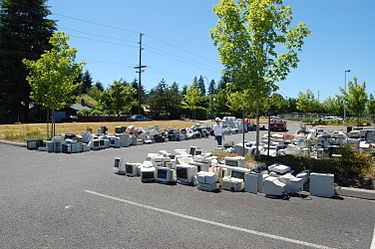
Wikipedia 375px-Computer_RecyclingTechnology changes at a rapid rate. It’s important for successful businesses to stay up-to-date with new technology. The site eWeek reports that a study done by Techaisle, an analyst and market research foundation, found companies that hold on to their computers for longer than three years, end up spending between $326 to $401 on maintenance of those computers with an extended warranty. For those companies without a warranty that figure jumps up to about $526 for repaired and upgraded computers. They also found that computers malfunction more often after a period of three years, and they suggest replacing them for the most efficient and cost saving measures.

A staggering figure of 355.2 million computers were sold globally in 2011. In 2010, the number was a bit lower at 346.2 million computers that were sold around the world. That means, about every three to five years a large number of those computers are being tossed out, in one way or another.

In 2005, social entrepreneur, Cormac Lynch from Dublin, Ireland, had a plan to do something with all those computers that were being thrown out into the landfills. He wanted to refurbish them for the children around the world, so that they could gain an education. The company he started was named Camara, which is West African for “one who teaches with experience.” In June 2007, 70 volunteers set off with 1,000 computers, and the initiative . . . (Read Full Article)

Mike Devlin’s Oasis in the Camden Food Desert


Dovecoate,_Vegetable_Garden_and_Fruit_Trees

The Camden Children’s Garden’s display at the Philadelphia Flower Show Photo Credit: South Jersey Magazine

A food desert is a place where there is no access to fresh, healthy produce or other foods. There are two types of food deserts in the U.S.  Urban food deserts are low-income areas located in the city that have no access to a grocery store, which sells fresh food within a mile of where someone lives.  In rural food deserts, the area expands to a ten-mile low-access area, which has no retail store with fresh food available. These figures are determined by census tracts.

The USDA states that 23.5 million Americans live in food deserts.  More than half of those are low-income, which also means they may not have readily available transportation to travel to where there is fresh, healthy food. An additional problem lies in the availability of fast food restaurants and convenience stores, which are more readily available, and could be contributing to the obesity and health problems of our country.

To see where these food deserts are located, go to the USDA Food Access Research Atlas.

One of these places is Camden, New Jersey — noted at various times to be the poorest city in the country and/or the most dangerous. It is also noted as being one of the nine worst food deserts in the U.S. There’s one social entrepreneur who has been trying to change that. It’s been a 30-year quest that Mike Devlin has been on to provide Camden residents with fresh produce. And, it looks like things are starting to turn around.

13322880714_e7a9eeb0fc_n

2014 Philadelphia Flower Show Camden Children’s Garden – Photo Credit: Dyogi

Devlin, executive director of Camden City Garden Club, founded the organization in 1985 with his wife Valerie. He has worked tirelessly, turning empty city lots into community gardens so that people can have fresh vegetables.  So far, there are 130 of these gardens throughout the city, and a study by the state of Pennsylvania found that  having produced the equivalent of $2.3 million in food for 2013.

Many offshoots of the Garden Club were born including Camden Children’s Garden, Community Gardening and Greening, Grow Lab, the Community Youth Employment Program, and the mobile market — a truck filled with locally grown fresh produce offered to Camden residents at reasonable prices.


There’s More Growing in Toledo than just Lettuce: Sustainable Local Foods

Bloom's Employees

It’s hard to imagine that a country, a little smaller than twice the size of New Jersey, could be the third largest exporter of fruits and vegetables. The Netherlands, United States and France rank as the top three in the agricultural global market. This small but mighty country depends on competing in the world trade marketplace for much of its income; however, the excessive agricultural production was weighing heavily on the side of soil depletion. They had to do something to stay in the game.

These days, research and development of agri-business sustainability are the Dutch government’s main focus. Over half their land mass is used for farmland, plus they are a leader in greenhouse horticulture. Experimentation with greenhouse design has proven favorable for a now-neutral use of energy consumption. Gardening under glass gives more control to the growing environment, saves water and lessens the need for chemical use. This type of food production is important for the Dutch to keep researching because they understand if their citizens eat well, there will be a reduced cost in providing government healthcare.

This food development model is what social entrepreneur Jim Bloom was after in Toledo, Ohio. Working as an employment recruiter, in a previous position, he was able to see a huge niche market in the area that was sorely being missed. With only 179 days of sunshine, Ohio ranks four spots above Anchorage, Alaska with only 150 days a year of sunshine — the least amount for the continental U.S. Because half the year is spent in cloudy weather, 98% of Toledo’s produce is shipped in from as far as 1,800 miles away. At the same time, area unemployment was at 5.7 percent.

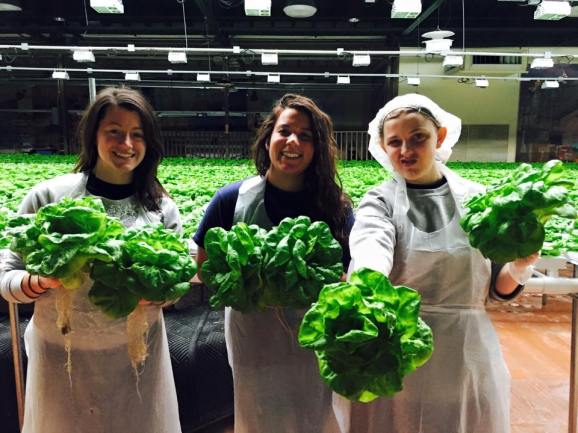
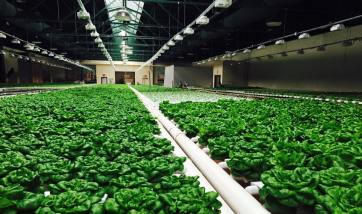
After much research of the European greenhouse models, Bloom started his company, Sustainable Local Foods, with a system of hydroponics. There is no need for sun or soil in this methodBloom's Place, and less water is used than in traditional farming. LED lights cut back on energy use and provide enough light for photosynthesis. The vegetable rows are planted weekly in flat, slightly tilted trays filled with the hydroponic solution. This system will provide year-round lettuce production with between 3,000 – 5,000 heads of organic lettuce per week. Besides a selection of lettuces, the company grows greens, tomatoes, peppers, and herbs.

Since 2012, expansion for the company has been steady with three current locations: Toledo, Columbus, and Detroit, Michigan. Bloom is currently waiting for an answer from Toledo’s commissioner of economic development to move into the abandoneBloom's Lettuced Erie Street Market, located in the warehouse district. In revitalizing the new facility, the community will be able to come in for garden tours. Bloom commented, “In January and February, I’m hoping that people will be able to come in here and enjoy the plants that are growing. There is a mental health benefit to being around growing living things in the dead of winter.” The idea behind this is to strengthen community bonds, revitalize the downtown warehouse area, and people will be able to see where the salad came from that they had last night. The produce is being distributed in area markets and local restaurants. If the company keeps blossoming, there is hope to expand across the Midwest.

When asked if he had gone to college before he started this venture, Bloom said, “Sure, I did. But, there was nothing in college that I took pertaining to agriculture. I knew nothing about agriculture. My background is in education and vocational rehabilitation. I wanted to start this business because of the economy here. I wanted to bring some life into the area and provide jobs for the people here. And, it is taking off exponentially. I wasn’t expecting that. Just about every week someone calls to ask me when I can come to set up in their neighborhood.”

Besides growing healthful local produce year-round in a sustainable environment, bringing community together in a revitalized downtown area, and providing grocery stores and restaurants with thriving organic produce, Bloom hopes this expansion will provide many more jobs for more of the out-of-work Toledo residents.

You can check out the company at their Facebook site.

Walters’ Holler

Stock Photo-Hyner Run State Park

Photo Credit: Hyner Run State Park Uploaded to Wikipedia Commons from Flicker – Author Nicholas A. Tonelli

In my first exploration of the Missouri Ozarks, I was looking at a charming underground house that I thought I wanted to buy.  They wanted $39,000 for three acres including the underground house, a barn they remodeled for a rabbitry (cages included), and a cabin.  It was a sweet deal.  However, the owner and I couldn’t meet eye to eye on it.

We checked other properties; there just wasn’t the “right fit” for what I was looking for. Even in Missouri, my $40,000 dollars wasn’t going to buy much from the dilapidated places we visited.

I had written my attorney a year before musing that I wanted a place with 5-10 acres, a creek on the property, and a little house/cabin that was at the end of the street for privacy.  As the week progressed on the real-estate expedition, my time was running out, and I realized then that I might be moving a little further than one county from the Wilder place where I wanted to be.  Nothing was showing any promise for purchase.

When the underground house fell through, my realtor said, “If you want something bad enough, you’re going to have to fight for it.”  My reply? “That’s not my karma.”  The realtor’s eyes lit up, and he ran to the file cabinet, came back, and threw a picture at me.  “This place isn’t for sale yet. The couple is here to clean it out and get it ready to list. Back in the 70’s, the area started out as a hippie commune, but reality struck when they ran out of money and had to go to work.  Some really nice people own it now.  They are lawyers from California.”  Well, he was a little bit off with the “lawyer” bit but continued to jaw about the place on the thirty-minute drive through hill and dale.

We bounced along down a really bad dirt road.  The dirt disappeared and was replaced with waist-high weeds.  Doril got out of the car to open the cow gate hindering our passage.  Down a steep hill, we went.  The car leaned far to the left.  I was losing my grasp on the dashboard that I grabbed to steady myself and started to slide on top of him, all the while thinking—Where is he taking me? Is the car going to topple over?  It was a scary and exhilarating ride down to the cement bridge that covered a gorgeous little brook, shimmering in the July sun.  “Sometimes this creek dries up in the hot weather, I think,” Doril chattered on.

We pulled up to a garage in the middle of the forest.  The owner had the doors open.  I saw the woodworking bench that ran almost wall-to-wall.  I was in love at the sight of it.  I tapped Doril on the shoulder and whispered, “I want this place.  Tell them I want to buy it.”  I hadn’t even seen the house yet.  But, the shimmering brook with the bugs playing in the daylight, and this magnificent garage where I could fix-up my fixer-upper, just melted my heart.  It was a place I knew from my heart.  I just knew I was home.

I went back to Greenwater, Washington, just 17 miles from the entrance to Mount Rainier, and wrote to my attorney as to what I had found.  She sent back that original email I had sent to her a year ago, explaining my hopes and dreams for my retirement.  And, it was exactly what I had found, my private little house in the woods with five acres, and a little creek in the forest.  This was going to be Walters’ Holler.

Note: Holler—a holler is a deep depression in the earth, like a small valley, but could also be enclosed on all sides.  Up North, in some places, it is called a hollow.  In the South, to my knowledge, it is a holler.

At-Risk Youths

images year up


According to the Bureau of Labor Statistics, Employment Projections report for 2012 – 2022, “Occupations that typically require post-secondary education for entry are expected, on average, to grow faster than occupations that require a high school diploma or less.” About 20.4 million new jobs will be available over this period. The report goes on to say that wages are higher for those with bachelor’s, master’s and doctoral degrees — averaging about $60,000 a year. Yet, it is estimated that 14 million of these higher-level positions will go unfilled due to the post-secondary educational requirements.

It doesn’t have to be that way. There is a large part of the population that is being neglected and ignored in our society.  It is common knowledge that low-income, urban young adults will never have the chance that their middle- to upper-class peers do when they graduate high school. Problems dealing with violence in school, problems at home, money issues, hunger, suicide, gang-related killings and substance abuse all weigh in heavily on these children in America. Sometimes just surviving day to day is all they can manage. Possibly one in three of these youths could end up with hood disease — a moniker given to inner-city kids with PTSD. If they do survive school and graduate, the employment prospects are pretty grim. According to Huffington Post, “Almost 6 million young people are neither in school nor working.”

It’s almost ironic that so many jobs will be available, but many young people remain unemployed for lack of qualification and/or training. So many are hungry for a chance, eager to make a place for themselves in the world, yet there is so little opportunity afforded them.

However, there is a chance for some through the social entrepreneurial company Year Up.  This organization understood that these young people could rise to higher expectations if the right situation presented itself. Flyers were sent out, inviting at-risk youths to apply.  The offer was this: Have a high school diploma or GED, show up for one year, learn skills in the financial field or in IT, get up to 23 college credits, and a stipend for expenses, work one-on-one with a mentor, and possibly hold an internship with a major company.

Social workers are on staff to help with private issues that may be insurmountable for someone so young; social skills in the workplace are taught so that the students will be able to function in a business social environment with grace and diplomacy.

The company has had spectacular results since it opened in 2000. They have served 8,500 young adults, and have provided interns for 250 corporate partners. Eighty-five percent of graduates are employed or attending college within four months of completing the program. Employed Year Up graduates earn an average of $15 per hour — the equivalent of $30,000 per year, and go up to $50,000 a year or more.

Companies like JP Morgan, which were once reluctant to take on these newly trained interns, are now eager to have them on board, and pay up to $23,000 for each intern at their company. Other corporate partners include Wells Fargo, Bank of America, Boston Children’s Hospital, American Express, The Huffington Post, Twitter and many others.

The “Each One — Teach One” Model

There is an incredible place in the United States, where some people are able to leave the depths of their despair, which has become the cyclic norm in their lives. These are murderers, thieves, people who sell their children for a fix, those whose lives consist of bouncing in and out of prison for ten or twenty years — or maybe for life. If they are some of the lucky few of the roughly 2.4 million people incarcerated in America, they’ve heard of a place where people can change, live a life of prosperity, and join the ranks of what might be construed as a “normal society.” This idea is only a fantasy to some of them — an unknown place over the rainbow because their version of normal is only what they’ve known their lives to be thus far.

This special place is called Delancey Street, “Where Hitting the Bottom, Begins the Climb to New Heights.” Mimi Silbert, CEO, president and founder, is a powerhouse of positive energy that she shares with everyone she meets. She has helped over 18,000 people overcome poverty, crime and substance abuse addiction through her working business model. There is no paid staff at this two- to four-year program for the underprivileged, and it is considered the most successful rehabilitation program in America.

Silbert came up with the idea when she worked as a prison therapist. One of the appreciative inmates stopped her on her way out the door one day and said that her advice was so helpful. Silbert’s philosophy is simple: she believes that there aren’t any bad people and there aren’t any good people — people are a mix of both. It is that positive belief that all people can pull themselves up, learn family values, learn cooperation, respect, and the skills needed to work within a society, that makes her model successful. They learn how to be positive team players. As soon as they walk through the door, they are told to leave their past behind because they are now working toward their future and their success.

The Delancey Street Foundation has a 91 percent success rate with six campuses across the U.S. To achieve this rate of success in a place with no help from the government and no paid staff, Silbert starts her program by teaching the basic skills: reading, writing, arithmetic, social interaction, and most important self-respect. She says, “It takes about two years for someone to stop judging and hating themselves, and believe they have actually earned who they have become.” They have to get through high school exams, learn three marketable skills, and it takes about four years to go through the whole program. Many of the graduates ask to stay on.

The question might arise, how does someone train more than 18,000 people without paid employees? Silbert started her project in 1971 with just four people in an apartment, a 1,000 loan and an idea based on cooperative family-type principles. People who held jobs outside the home would contribute money to the business. They carried that idea further; if someone could cook, they would run the kitchen; if someone knew construction, they would be in charge of building and fixing things, and so on. As they brought in more people, those who were established in the program would teach the newcomers. Those people would teach the next group that came in.  Within two years, they were able to buy their first building in the poshest neighborhood, Pacific Heights, and had 80 residents all living together and helping each other. Because of their locale, there was a problem with the neighbors who weren’t so keen on having criminals living next door. Silbert solved the problem by starting a neighborhood watch and volunteering the services of the residents living there — crime levels dropped. The building was remodeled by the construction crew to keep property values current or better. To raise funds for the reconstruction, the group sold raffle tickets in the neighborhood promising they would “not move next door to you.” Almost 20 years later, when they finally moved to their newly self-built housing on the waterfront, their humor and good neighbor attitudes had won everyone over, and the Pacific Heights neighbors were now sorry to see them leave.

Silbert’s model works because she focuses on what people “can do” not what they’ve been through, how they were raised, or where they’ve resided in the past for whatever crimes they may have committed. All that is left at the door when they step through the portal to this new world that they have only heard about or have seen on TV. They learn that they can change, they can trust people, and they can be responsible, which in turn builds self-respect and self-esteem based on whom they have become.

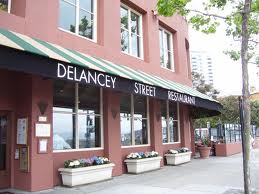
The Delancey Street project has grown through businesses run by these people who once felt they had nothing to contribute. The cornerstone business was a fine dining establishment. The community has grown to include a café – bookstore, catering, private corporate car service, digital printing, specialty advertising, handicrafts, landscaping, a moving and trucking company, a paratransit service, a movie screening room, and selling Christmas trees and a decoration service.

Foundation is the perfect classification for this business. How many lives have been changed by the strong foundation that Mimi Silbert has provided for these individuals?  How many more of the 2.4 million people, struggling in a life that seems devoid of hope, could be changed by her model project?

Tiny Homes for the Homeless

Brian Reynold's Photo for Kloehn

Photo Credit: Brian Reynolds

There is an estimated 1,750,000 people with no place to live as of June of 2013 in the U.S. Think of how their lives would change if they had a little house to come home to every night—a place of shelter from the weather, protection from thugs on the street, and some place they could call their own. This is the dream of artist-architect Gregory Kloehn.  He builds little tiny homes for the homeless. Featured on Rachel Ray, Inside Edition and Huffinton Post, Kloehn got the idea from his own challenge to renovate a dumpster to live in. The adorable dumpster is fully functional with a kitchen, bed, potty, shower, a deck up top complete with umbrella, and an awning.

Building the dumpster kindled the joy he had as a child building his creations.  Kloehn writes,

There is a spontaneity and playfulness in making small homes that traditional houses do not offer.  It reminds me of making forts as a kid, no city planners, no architects, no crews, no bank loans, just my ideas and my hands.” His love of helping people was naturally the next step in this passion of his. He started building tiny homes for homeless people in his neighborhood.

Tiny houses are not a new concept in our culture. With real estate far out of the reach for the average person now, people are looking for alternative housing ideas. What sets this idea apart from an average tiny house is that they are given away for free to the people in our country who need the most help. Here are some thoughts from Kloehn on why he is so excited.

Tiny houses are striking a number of cords in our society. They are not just homes but fast becoming a lifestyle option. They are, usually, (but not always)  cheaper than regular homes, giving more people the opportunity of ownership. By skipping the traditional 30-year mortgage, perhaps the tiny home movement could even reshape the way we think about work and what we want to accomplish with our lives.

The tiny home movement is also embracing and mixing all forms of new and old technologies, making them hotbeds of ingenuity, creativity, and environmentalism. Small spaces means that it’s easier to power an entire house with the sun or wind, and water can be collected, used, used again and reused with simple catch and filtration systems. Even black waste can be turned into methane and/or composite for food production. From the loner in a simple tipi, to the high-tech self-contained living pod, the tiny homes have something for everyone.

Many of the tiny homes are on wheels or small enough to be moved with relative ease. I think this degree of mobility is one of the most revolutionary aspects of the tiny home movement; what if you bought or built the home you wanted, then rented the land. Your customized home could follow you wherever you needed to be. If you built a home that followed you throughout your life, I bet you would be a bit more thoughtful in your choices.

With these little houses for the homeless, portability is essential because the city will make a homeless person move every few weeks. You can see the wheels in the photo (above) from photographer Brian Reynolds.

Another perk to this tiny home project is that Kloehn is cleaning up his neighborhood by working almost exclusively with recycled materials. He uses abandon wood, bed frames, futon frames, solid doors, auto glass … anything that might work to build up a tiny house. Most of the items are found. Some of them are donated by businesses. For the parts that can’t be found through recycling, Kloehn is relying on donations from the public. He’s hoping the idea catches on so that other people will build homes for the homeless. With this idea in mind, he is willing to travel to teach workshops on how to build these for anyone who wants to help. They only take a little more than a week to construct.

It might not be a perfect solution, but one thing is certain, social entrepreneurs like Kloehn are going to have some of the answers for the problems that have been plaguing our society. It is these creative minds with a strong educational background who are going to bring back the hopes and dreams that seem to have slipped away for a great deal of people in our country. Wouldn’t it be great if Landesa could find some micro-acreage for tiny homes, and if HandUp could help with supplies, and if Kloehn’s tiny houses could be established then … maybe, just by having a place to put their heads at night,  a place to keep warm on a cold winter’s day, a little place they could call home—these forgotten people in our country wouldn’t feel so homeless anymore.